Method
A quick refresher on the frameworks from the book, enough to bring their shape back to mind. If you read it a few months ago and want the ideas loaded again before the next briefing, that is what this page is for. The full argument, the original cases, and the reasoning all live in the book.
The master choice: retrofit or reimagine
Every enterprise putting agents to work is making a choice on a spectrum, usually without naming it. You can use agentic AI to make your existing operating logic run faster and cheaper. That is a retrofit. Or you can use it to redesign that operating logic itself, building the work around what humans and agents can do together. That is a reimagine.
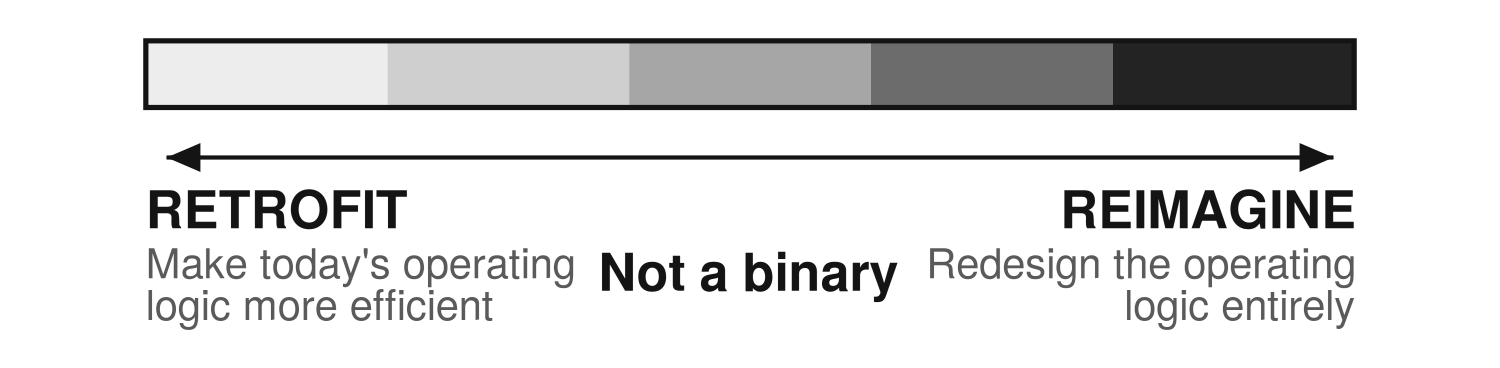
The diagnostic is one question. Does your objective require running the same operating logic faster, or a different operating logic at a different shape? Same logic faster is retrofit. A different shape is reimagine. Most firms do some of each in different functions, which is fine. What matters is knowing which one you are doing in a particular situation, and doing it on purpose.
And neither end of the spectrum is safe. Retrofit looks conservative and quietly cedes ground to whoever redesigned the work. Reimagine looks bold and can collapse under its own ambition. No position on this spectrum removes the risk. The only thing you control is whether you chose your spot deliberately.
The position keeps moving
The right position on that spectrum is something you continuously navigate, because the current keeps moving it.
Agentic capability keeps advancing, and as it does, the pressure to reimagine grows and the ability to reimagine grows alongside it. The position that was right for a given piece of work last year has already drifted toward reimagine, and it will keep drifting. Sometimes the current is gentle, sometimes it surges, and once in a while an obstacle upstream slows it for a stretch.
So the question worth asking changes. It is no longer: where should I sit on the spectrum. It is: what tells me the right position has moved, and how fast I can move with it. That is the whole reason the book is built around a river. The work is navigation, not selection.
Where the choices get made: the three Tensions
The master choice is not made in the abstract. It gets made operationally, in three places, every time you put a real piece of work in front of an agent. Picture them as three settings on the boat - your domain of control - that you navigate through the current.
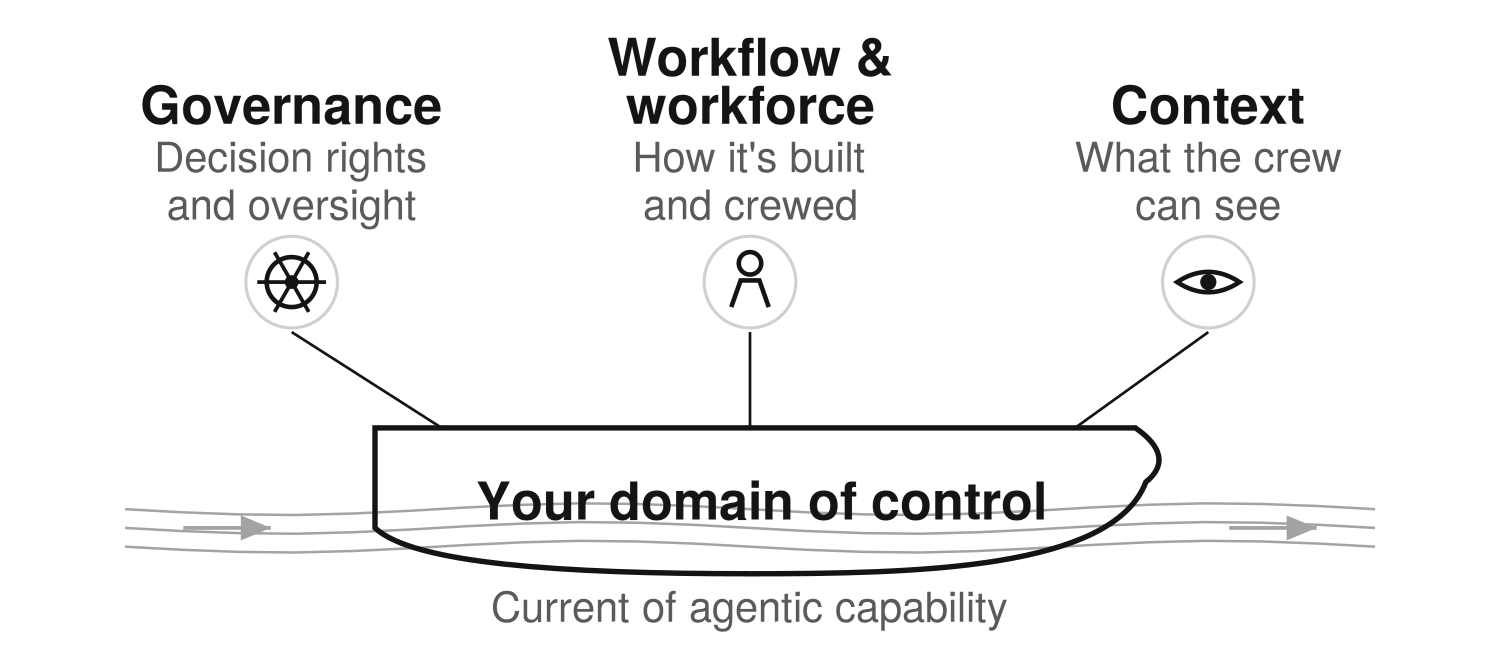
They are set together, all three at once, with no correct order between them. Every piece of real work needs all three considered.
Workflow and workforce. How the work is built and who, or what, staffs it. Do agents take existing seats in the existing workflow, or do you redesign the workflow and the roles inside it together? One end slots agents into the org you already have. The other reshapes the org around what humans and agents can do together.
Context. What the crew can see. How much organizational knowledge you hand the agents, and how far it reaches: inside one function, across the enterprise, or out to partners and customers. The uncomfortable part is that the context you own and the organizational influence you hold turn out to be nearly the same thing, which is what makes handing it over feel like giving something up.
Supervision, autonomy, and governance. The decision rights aboard the boat, and what catches a bad call before it does damage. How much the agent does without a human in the loop, and whether your guardrails are bolted on after the fact or built into how the work runs. Autonomy without governance is reckless. Governance without autonomy is theater.
Reading the Water Together
The Discussion and Reflection Guide is designed for leadership teams who want to work through the book's frameworks together.
The facilitated version of this session is described on the Sessions page.